Stand at the gatehouse of a ruined religious house and the same question tends to surface: was this a priory, an abbey or a monastery? The three words get used interchangeably in guidebooks and on tourist signs, yet they described quite different institutions. A small dependent cell and a great landholding abbey could both be called religious houses, but their governance, population, income and buildings rarely resembled each other.
Getting the terms straight makes a walk around any site more rewarding. You start noticing why one church has a short nave and another rivals a cathedral, why some ruins cluster around a cloister and others consist of a single hall, and why a bishop or a distant abbot once cared about who lived here.
Monastery is the broadest of the three words. It describes any community of men or women living under a religious rule, withdrawn from ordinary secular life and committed to prayer, work and shared property. The word comes from the Greek for a solitary dwelling, but in practice most monasteries were busy, populated places.
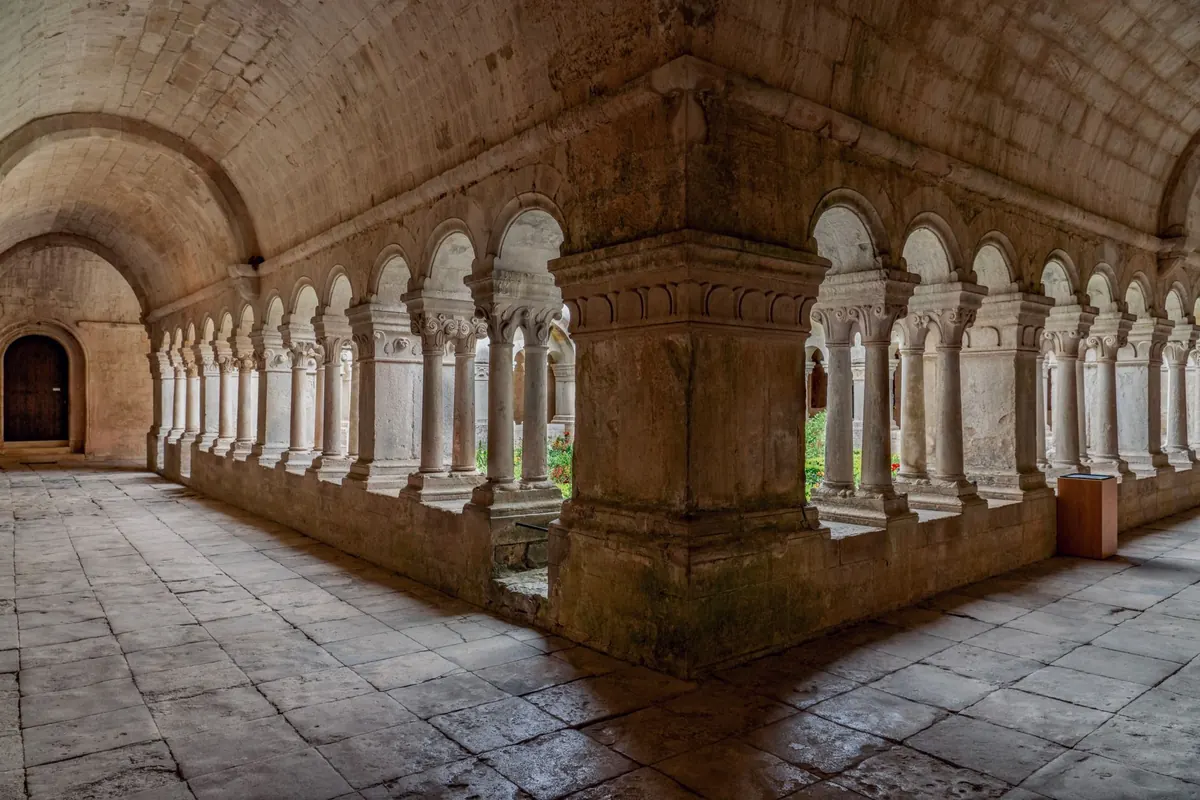
Because it is a general category rather than a rank, a monastery can be an abbey, a priory, a friary, a nunnery or something else entirely. A Carthusian charterhouse, where monks lived largely as hermits in individual cells around a cloister, was a monastery. So was a Cluniac house of a hundred choir monks. The term tells you what kind of life was lived, not how the house was governed.
Two broad families dominate the European story:
When you see the word monastery on a site panel without any other title, read it as a neutral description. The interesting question is always what came next: was this house self-governing, or answerable to someone else?
An abbey is a monastery that governs itself. Its head is an abbot or, for a community of women, an abbess. That leader is normally elected by the community, holds authority over the house and its estates, and answers in the first instance to the order's structures or the pope rather than to a local bishop.
That independence is the defining feature. It is also why abbeys tended to be large and wealthy. A self-governing house could accumulate land across many parishes, hold the right to appoint priests to churches, collect tithes and tolls, and negotiate directly with kings. Some abbots sat in parliaments and wore mitres, ranking alongside bishops at great ceremonies.
Independence brought obligations too. An abbey typically ran a substantial estate office, a kitchen feeding dozens or hundreds, a guesthouse, an infirmary, a school or scriptorium, and often a workshop range. The buildings grew to match. If you are looking at a site with a cruciform church of cathedral-like length, a full cloister with chapter house, refectory, dormitory and warming room, plus an outer court of barns and stables, you are almost certainly in an abbey.
A priory is headed by a prior or prioress and is, in the classic case, subordinate to an abbey or another mother house. A monastery might plant a priory on a distant estate to manage its lands, farm its granges and say mass for tenants. The prior governed day to day, but the abbot retained overall authority and might visit to inspect accounts and discipline.
This is where the tidy rule starts to leak. Some priories were effectively independent, especially cathedral priories, where the prior led the monastic chapter that served a cathedral and the bishop was technically the nominal abbot. Others were small enough to be called cells, with perhaps three or four monks and a chapel. And a handful of houses styled priories were genuinely large and rich, outshining modest abbeys nearby.
Size, then, is not the reliable test. Governance is. A priory that answered to a mother house has left a different paper trail and often a different footprint: fewer monumental buildings, more emphasis on the estate centre, sometimes a church that doubled as the parish church for local people.
The clearest way to compare the three is to ask who held authority and who owned the property.
At a monastery, the answer depends on which sort you mean. At an abbey, an elected abbot or abbess holds the reins, the house owns its lands, and the community is legally a corporation. At a priory, a prior or prioress runs the place under the authority of a mother house or a bishop, and the parent institution usually takes a share of the income.
Wealth followed governance closely. Abbeys, with their wide estates and legal privileges, could fund ambitious building campaigns over centuries. Dependent priories sent surplus revenue to their mother house and had less to spend on stone. That is why a county may hold one spectacular abbey ruin and several priories reduced to a few footings and an earthwork.
Read the site's title as a statement about authority before you read it as a statement about size.
You do not need a documentary history to make a good guess. Look at four things.
If a site panel gives both a title and an order, use both. A Cluniac priory dependent on Cluny tells you about governance; a Cistercian abbey tells you about a self-governing house in a reform movement that deliberately built away from towns. The order shapes the plan as much as the rank does.
Keep the hierarchy in mind and the confusing signage sorts itself out. Monastery is the general word for a community living under a rule. Abbey is a self-governing monastery led by an abbot or abbess. Priory is a house led by a prior or prioress, usually under the authority of a parent house or a bishop, though the exceptions are frequent enough to keep the subject interesting.
Before you go, check the historic county records or the local heritage list for the house's status and mother house, and note whether the church survived in parish use. On site, walk the cloister first and the outer court second, then stand at the gate and imagine the boundary the community maintained. That sequence will tell you more about rank and wealth than any single label on a postcard.